Tuesday, December 19, 2006

Sometimes, God's Gift is an Empty Box

For Christmas this year, God gave me an empty cardboard box. Doesn't sound like a very good present, does it? (Unless, of course, you're a 3-year-old who likes to build box forts, or a very curious puppy.)

But for me, it was the right gift at the right time. Lately, I've wondered, "Do I have any faith whatsoever? Do I even have a mustard-seed worth of faith?" And my own answer to those questions was: Maybe not.

That's because my own faith hadn't been tried and tested lately--or at least, not that I was aware of. Then God gave me that empty box.

A couple months ago, I learned about a church-run program that helps women break their addictions to drugs. Some were battling against heroine, meth, and the like. Others were fighting addictions to codeine, Valium, and other prescription drugs. And all were squeezing out every bit of their faith, doing their best to keep believing God could help them overcome. Day by day. Hour by hour.

As I listened to the stories of a few of these women, their deep trust in God blew me away. I remembered how I'd had to trust God in the past. Through tough times, my faith got stronger. At that moment, I prayed one of those crazy prayers, "God, I want to trust you more. Just like these women do, every day."

Ever prayed like that, then wished you hadn't? I'm usually afraid to ask God for strength in any particular area of my life. It's almost like I'm asking him, "God, please send some bad or uncomfortable situation so I can learn from it." And I wondered what awful mechanism God might use--plague, plight, or pain--to make my faith stronger.

What a puny, human brain I have, to think God only could use some "punishment" to teach me! Well, he sent me an empty box.

Let me explain. I'd found out the women from the drug rehabilitation program loved Christian music. I used to be a Christian music reviewer, so I had tons of CDs. When I heard about their desire for music, it was a no-brainer: I would donate some CDs from my personal collection to their program.

I selected perhaps a dozen CDs, and that was gonna be that. Then I got to thinking, "Hmm, I wonder what Christianbook.com might have on sale." Again, I know a little bit about Christian music, so it didn't take me long to search their catalog for the good deals. I found some great stuff in their clearance section priced at 99 cents and less, so I ordered a bunch of CDs. And that was gonna be that. All I needed was a cardboard box so I could mail them off.

The Christianbook.com CDs arrived in a cardboard box. So I figured, "Hey, God even sent me a free box! How convenient!" But after placing my old CDs inside with the new ones, about two-thirds of the box was still empty. I stuffed packing paper inside, which just made my donation look even littler. Pitiful.

There seemed to be two options: 1) fill this box, or 2) get another box. With the first option, I'd need to donate every Christian CD I owned to fill up that 12-by-15 inch box. And the second option, well, that just seemed like a cop-out. But donating all my CDs? That would be a big, painful sacrifice. I'd lent CDs out and given some away over the years, used them for writing inspiration, and just enjoyed listening to them in my car. We don't get good reception on any Christian radio stations out here by the beach, so if I gave away all my Christian music, that would mean I'd have ... nothing.

I was willing to make the sacrifice. Yet in my heart, I felt that wasn't the point of this box. It seemed God was telling me, "I'll fill it up. You'll just have to trust me."

I sent an e-mail out to friends and family, asking them to donate Christian CDs. And then, I waited. I'd given everyone a deadline of December 10 to give me CDs for the box. The deadline came and went. On December 11, my "box of faith," as I'd named it, had a mere four more CDs in it.

"Be patient," God told me. "I told you I'd fill the box, and I will."

But when? Surely the box could get filled if I waited 10 years. I wanted to give these CDs to the women's program before Christmas, and that seemed impossible. It would take another 50-some CDs. And where were all those gonna come from? Would they just fall from the sky?

On December 11, I almost abandoned the box of faith. Yet something inside me--something very small--told me to hang in there a little longer.

On December 12, someone gave me three CDs. On December 13, several others gave 35 more. I thought, "Wow, God might really do this!" On December 17, another person brought another five. Now, there was only space for eight more. I decided I'd grab eight from my own collection. But God told me, "Just wait. Remember, this is about you trusting me."

Last night, I went to my parents' house to pick up some CDs my uncle had dropped off earlier in the day. As we popped them into the box--one, two, three, four, five, six, seven, eight--even I was a bit astonished to see the box of faith had been completely, perfectly filled to capacity.

I'll be taking 86 Christian music CDs to the drug rehabilitation program this week. I know the women there will be thrilled to get this gift for Christmas.

And I received a special Christmas present, too. It was an empty box. I never told anyone the size of the box or how many CDs were required to fill it. It was filled on faith: my weak, imperfect, tiny faith. It was filled by a God who's bigger than my doubts, bigger than my smallness. And so much bigger than an empty box.

To ponder:
1) What is your "box"? In your life, what things seem too big for God to handle?

2) Are you ever afraid to ask God to make you stronger? What causes that fear?

3) Do you believe spiritual growth always has to be a painful process? Think about some positive ways God has helped you to grow. (For example, perhaps you've looked at a rainbow in the sky or watched a beautiful sunset and realized something about God's character. Or perhaps you heard some encouraging words in your pastor's sermon, or got an unexpected hug at just the right moment and knew it came from God.)

Monday, December 11, 2006

EPA Member, Ordinaire

Maybe you noticed my new little logo. I've joined the EPA.

I'm now a full-fledged Associate Member of the Evangelical Press Association. (And you thought I got a job with the Environmental Protection Agency!) What does that mean? Basically, I've confirmed I agree with the EPA's Code of Ethics and Statement of Faith.

But what does it really mean to me? I've often wondered about my own affiliations and the labels I give myself--and why others do the same. Why do we register with political parties? Why do we join churches? Why do we get certificates when we complete schooling or an educational program? Why do we take on the titles "husband" and "wife" when we marry? Do pieces of paper, affiliations and titles change who we are?

For me, my affiliations and labels don't change my thinking; rather, they focus me on what's already there. They're personal reminders of my priorities. Their symbolism is meaningful to me. So I've put the EPA logo right smack in front of my face, where I'll see it every time I'm working on this blog. It will remind me of my commitment to God to use the writing abilities he gave me as best as I can. That little logo is a great visual tool for me.

Nope, I didn't get any smarter or better equipped. I didn't gain any extra expertise. I wasn't recognized for passing a test or reaching a benchmark.

I just got a little more committed.

To ponder:
1) What are some of your affiliations? What labels do you give yourself?

2) Why did you choose these affiliations/labels? Why are they important to you?

3) Do you affiliate or label yourself more for the benefit of others, or for yourself?

Monday, December 04, 2006

A Black Evangelical's Inside View of White Christianity

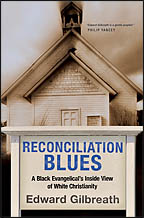
My friend Ed Gilbreath has just published a book: Reconciliation Blues: A Black Evangelical's Inside View of White Christianity.

Ed is the editor of Today's Christian and an editor at large for Christianity Today. In the late 90s he was associate editor for New Man, the official magazine of the Promise Keepers men's ministry. He is a coauthor of Gospel Trailblazer (Moody, 2003), the story of African American evangelist Howard O. Jones, the first black evangelist on Billy Graham's crusade team.

Ed's writing is mindblowing, so I'm very excited to read it. You can check out the prologue and first chapter online at ReconciliationBlues.com. Here's a bit from the book:
________

I’ve never thought of myself as "the token black," but I have enjoyed the privileges of being the only African American in the house. For a long time, I lived in blissful denial of the inadequacy of this arrangement. While certainly conscious of race, I didn’t consider it something that would affect people’s perceptions of me, nor did I allow it to influence my view of others. I wore color-blinders.

I was the approachable black guy, the white community’s friendly interpreter of all things African American. And hey, it was great! I admit it. At moments, I prided myself on being the only black person some white people would ever know personally. When another black person would come into the picture from time to time, I’d feel threatened—like they were trying to intrude on my territory. "These are my white people!" I’d think.

The problem, of course, is that no single person can legitimately represent an entire race. Though I lived with that delusion throughout much of my young adulthood, I got a rude awakening once I began to ascend the professional ranks at white evangelical institutions. After a period of racial hibernation, I awoke to the reality of my otherness. I realized once and for all that, as an African American evangelical, I am a black Christian in a white Christian’s world.

________

Friday, December 01, 2006

What's the Point of Praying?

"My vacation was great!" my friend M joyfully reported at our church small group. "I didn't have any back pain the whole time."

When I heard this good news, I wanted to jump up and shout, "Woo hoo! I prayed for you every day, M!" But something held me back. I thought to myself, Hey, what did you do for M's back? Nothing! It was just a God thing, so keep your prideful little trap shut.

A few weeks before, our small group leader had asked each of us to write a prayer request on a piece of paper. Then we took turns selecting each others' requests out of a hat. We were supposed to pray for that request for the week, and I did. I really wanted to tell M I'd prayed for him, but part of me felt it was somehow wrong. It seemed like saying, "I prayed for you," would be stealing some of God's thunder. So I kept quiet.

As I headed home after small group, some familiar doubts popped into my mind. Why did I pray for M? Didn't God already know what everybody needed? Wasn't God going to do whatever he pleased anyway? Why did I pray at all?


Now, I know there are plenty of good reasons for praying: We pray to remind ourselves there is a God who's bigger than us. We pray to include God in our lives, to keep him in our conversations and thoughts. We pray for things more than once because the Bible says our persistence gets noticed (Luke 18:1-8). We even pray simply because Jesus did, and the Bible says we're supposed to pray (Philippians 4:6-7).

But knowing all these reasons doesn't stop my brain from questioning the purpose of prayer every once in awhile. That's when I have to make a choice. Do I get frustrated with the questions, throw up my hands and shout, "Yeah, what's the point?" Or should I face off with the questions, talk to God about them, and perhaps learn something he wants to show me?

I decided to let the troubling questions sit in my head, and to pray about them. The next day, I got my answer. I remembered a recent conversation with my husband that went something like this:

ME: Honey, I'm going to the grocery store. Do you want anything?

HUBBY: I want ... something.

ME: Well, what do you want?

HUBBY: I want ... something. Something good ...

ME: What is "something good"?

HUBBY: You know the stuff I like. Something like that.

ME: Yes, I know what you like. But what, specifically, do you want?

HUBBY: Good things.

ME: What is good?

(The conversation goes on for another 20 minutes, then finally ... )

HUBBY: Salami is good ... bread is good ...

All to say, my husband wanted his favorite sandwich items. Thing was, I already knew exactly what he wanted. I had these things written on my shopping list. But I really wanted him to ask me. Why? Well, I guess it makes me happy to hear he trusts me to meet his needs and take care of him. And I just enjoy when he asks.

This got me thinking: Maybe God likes to be asked, too. Maybe God especially enjoys when I say, "Hey, Dad, I don't need anything for myself today. But would you do something for my brother M? He really needs your help."

Has a child ever asked you to do something for their friend or even a stranger? It is overwhelmingly moving--if you've experienced this, you know exactly what I mean. We're made in the image of God, so it follows he's probably moved when his kids pray for each other, too.

Of course, this was just me speculating about God--until I looked up an old, familiar verse: "Ask and it will be given to you; seek and you will find; knock and the door will be opened to you" (Luke 11:9, NIV). Somehow, I'd never before noticed the example Jesus gives preceding this verse:

Then [Jesus] said to [his disciples], "Suppose one of you has a friend, and he goes to him at midnight and says, 'Friend, lend me three loaves of bread, because a friend of mine on a journey has come to me, and I have nothing to set before him' (Luke 11:5-6, NIV).

This request for bread is made for the benefit of the host's friend. (Kind of like how I asked God to help M because I had no means of helping my friend.) Additionally, we know the journeying friend has approached the host with his need for food. (Kind of like how M shared his prayer request about his back pain.) And the passage continues on:

He may not get up and give you the bread, just because you are his friend. But he will get up and give you as much as you need, simply because you are not ashamed to keep on asking. (Luke 11:8, CEV, emphasis mine)

Wow! I felt God had directly told me, "Yes, Holly, I want you to pray for others--they're your sisters and brothers. You shouldn't be ashamed to ask me repeatedly. And you shouldn't be ashamed to tell your friends you've asked me to give them something."

So I wrote this little blog entry to tell M: My friend, I prayed for you every day. It makes me feel really good that God took care of you.

And next time, I'm just gonna tell you so.

To ponder:
1)
Do you tell your friends you're praying for them? Why or why not?


2) What stops you from praying? What fears and questions enter your mind when you pray?

3) Is it harder for you to pray for yourself, or for other people?
4) What makes specific prayers difficult for you? (For example, maybe you've prayed for yourself or someone else in the past, and God didn't give you or your friend the thing you asked for.) What makes specific prayers easy for you? (For example, maybe you've built up a lot of trust with God in an area of your life.)

Religious Folk are Biggest Givers

From "Cheap in America," a special 20/20 aired on ABC Wednesday:

20/20's John Stossel: The single biggest predictor of whether someone will be charitable is their religious participation.

Religious people are more likely to give to charity, and when they give, they give more money: four times as much. And Arthur Brooks [author of the book Who Really Cares] told me that giving goes beyond their own religious organization:

"Actually, the truth is that they're giving to more than their churches," he says. "The religious Americans are more likely to give to every kind of cause and charity, including explicitly non-religious charities."

MORE:
Who Gives and Who Doesn't?


To ponder:
1) Why do you think religious people tend to be more charitable?

2) What motivates you to be charitable? Are your motivations different when you do volunteer work than when you give money or goods?

3) What do you think are the biggest obstacles to being charitable?

Wednesday, November 29, 2006

Larger Than Life, Yet Relatively Unknown

"We've been closing the gap between what you would hear in church and on a rock radio station. Artists like Chris Tomlin help bridge the gap more and more."

--Matt Lundgren, worship leader at Willow Creek Community Church in South Barrington, Illinois. The quote is from a Time magazine article about Chris Tomlin, pictured right. Tomlin's songs are the most often sung contemporary music used in U.S. churches today, according to Christian Copyright Licensing International (CCLI), an organization that licenses music to churches. And, as the article speculates, this could make Tomlin the most often sung artist anywhere. Yet very few people--even churchgoers--have heard of Tomlin, the article asserts. Time writer Belinda Luscombe sums it up this way: "Tomlin doesn't want to be Prince. Music immortality is fine. It's just not the sort he cares about."

FULL ARTICLE:
Hip Hymns are Him

Monday, November 20, 2006

Tell a Jewish Friend Jesus Came for Them

We have to change our belief that Jews need to be "converted" to Christianity. Jews will always be Jewish. Jesus was Jewish. We gentiles are the ones who are converted when we become Christians, or followers of our Jewish Messiah, Y’Shua.

--From Karen Covell's article "Chosen by Jesus," which appears in the Nov/Dec 2006 issue of Outreach magazine. The article discusses how Christians can more effectively share their faith with Jewish friends by putting the Gospel into a Jewish context. This includes acknowledging Jesus came first for the Jews, then the gentiles (Romans 1:16).

MORE:
Chosen by Jesus

History of Hanukkah (The History Channel)

Judaism 101

Monday, November 13, 2006

Angels, Revisited

I blew it. Again.

I was in a hurry, pushing a cart full of groceries through the parking lot as fast as I could. A list of errands was running through my mind. Still had to stop at another store, pack for my weekend trip, and make sure my husband had enough clean socks and underwear to last through the days I'd be gone. With my mind focused on the tasks ahead, I was hardly aware of the man standing in front of my car. I heard his voice before I saw his face.

"Excuse me, ma'am. Could you help me with something to eat?"

He stood at some distance from me, probably well aware I might freak out if he came closer. And though he was safely at least a dozen feet away, and both my shopping cart and car were barriers between us, I'd still felt a rush of fear. His face was oily, and his faded black pants and t-shirt were rumpled and dirty.

"Sorry." I tersely dismissed him with that one word, then immediate returned to the task of loading the groceries into my car. I anxiously hoped he'd disappear.

And as soon as I said it, I regretted it. As he walked away, I felt a heaviness in my chest. I knew in my heart I needed to stop what I was doing, run after the man, and tell him I would get him some food. For goodness sake, I had a whole cart full of groceries right there, including some I'd bought to take to my church! Go find that man right now! my heart demanded.

But when I looked down at my groceries, I thought, I can't just leave these here and run after some stranger. I'll put them in my trunk first, then go find the man.

This is the point where I knew I'd blown it. I knew the man would be gone. I knew I'd look for him, and that I wouldn't find him. I knew he would disappear from that little parking lot, as if he'd mysteriously been zapped off the face of the earth.

I knew all of this would happen because it's all happened to me before.

About three years ago, I was driving by a different grocery store in Illinois. It was cold and drizzling, and I just wanted to get home because I knew it would start pouring at any moment. My husband and I had just bought a new car, and I was terribly nervous about driving it on a dry street, let alone a slick, wet one. I didn't want to be driving when the serious rain began. When it rains in Illinois, water falls from the sky in sheets, not droplets. Heaven help the person caught walking on the street during a storm--it's like having buckets of water forcefully thrown at you from every direction.

Heaven wanted to help an elderly woman that day. I saw her walking out of the grocery store and couldn't take my eyes off her. In one hand, she carried a few bags full of groceries, in the other, she attempted to keep her little umbrella upright as the wind tossed it backward. She could barely walk; she dragged one foot a bit as she inched down the sidewalk with tiny, strained steps. The signal on the street turned red, and I watched as she slowly moved in my direction.

Offer her a ride. Help her. The words in my head were as clear as if they'd been said by someone sitting in my passenger seat. The feeling I had was more than just a nagging conscience; I knew God was directly instructing me to help this woman. All I had to do was pull over to the curb.

The light turned green. I can't stop for her, my head rationalized. There's no parking lane on the street. The cars behind me will honk. She'll think I'm a lunatic and will be scared--what if I give her a heart attack? I came up with a dozen excuses as my foot moved from the brake to the accelerator. I watched her in my rear-view mirror as I drove past. There was still time to stop for her.

I turned at the corner. I've got to get home before the rain starts pouring down.

And then it hit me: I hadn't stopped. Nearly every part of my body had urged me to stop. My foot had been resting on the brake. My left hand had been ready to flip on the turn signal. My arms had been ready to turn the wheel. My heart was thudding so strong and deep I could hear it in my ears. Yet I hadn't stopped.

I pulled over and turned my head to look over my shoulder. I couldn't see the old woman anymore. The rain began to pour down.

I hadn't stopped. I'd said "no" to God. I began to bawl and howl like an injured animal.

And I knew I had to find the old woman. I had to make things right. I had to get her out of the pouring rain. I had to do what I should have done in the first place.

I sped around the corner. I figured I'd find her right away. At her snail's pace, she couldn't have gotten more than 100 feet from where I'd turned. I drove past the intersection where I'd seen her. Not there. I drove another block. I drove down the side streets, then through the parking lots of nearby businesses. Even as I searched, I knew I wouldn't find her. I knew God had offered me an opportunity, or rather, a test. And I'd failed it.

I bawled all the way home, trying to comfort myself with the thought someone else had picked her up, or that she'd found refuge at a bus stop or under a store awning. Those thoughts didn't soothe me. I prayed, "God, I missed what you put right in front of my face. But I'm going to be aware now. I'm going to listen when you ask me to do something. I won't blow it again."

For the next several weeks, my actions played over in my mind like a CD stuck on repeat. I begged God, "Please give me someone to help! Please give me something to do for you. Please let me make up for my inaction." I thought about Jesus' illustration of the
three servants who were given different amounts of money to invest for their master. And I thought, "I'm the foolish servant who buried the master's money and didn't even earn basic interest from the bank." In the weeks that followed, I looked everywhere for an opportunity to help another person. I held every door open, told everyone who sneezed, "Bless you," extended kind greetings to every passerby. Every day, as I drove by the intersection where I'd seen the elderly woman, I looked for her. Nothing gave me peace.

But as the days passed, the memory gradually faded. I got caught up in work and my never-ending to-do list. I'd almost forgotten about the old woman when I read an article, "The Test," in Today's Christian magazine. In it, a man shared his memory of an elderly homeless man who'd visited his church. The homeless man had come in during a Sunday service and asked the congregation to help him get some food. No one offered to help him. So he walked back out empty-handed. As soon as he'd gone out the door, a few church members ran after him to offer their assistance. But he was gone. He'd seemingly vanished. Afterward, the senior pastor got up and told his congregation:

"Something terrible happened here today. We missed an opportunity to prove ourselves, and I fear we may never receive it again ... I believe we received a visit from an angel today. My mother taught me, when I was just a boy, that God sends his angels down to look after us and to guide us … but he also sends them to test us, to see what kind of people we really are. I think we were tested today. And I think we failed."

I bawled three years ago when I read that story, and I ache as a read it again today. Because I know I've been tested many times now. Many times I've "passed"--I did what I knew God was asking me to do. I'm thankful God softened my heart and opened my eyes during those moments. When I help someone, I almost always feel wonderful afterward. I feel connected to God and to humanity. I feel more like a person, and less like a machine that's programmed to never deviate from its routine.

Last week, I was a robot, following my usual pattern of ignoring people, rushing to complete chores, and strictly sticking to schedule. With a fat wallet, a full belly, and a cart full of groceries, I turned my back on a hungry person who simply asked for something to eat.

Today, I feel that old familiar pain of heartbreak. I hurt, knowing I left an old woman to walk in the cold rain three years ago, and a homeless man to wander on last week, with his stomach still empty. I hurt, knowing my lack of compassion perhaps made those two people feel a little less loved and cared for by God. I hurt, and I welcome the feeling. I hope it lingers for a long while because it reminds me of who I am--a child of God, with billions of brothers and sisters who are hoping some "stranger" will offer them the tiniest bit of kindness. They pray God will send them someone who can give them enough hope to get through one more day.

Today, I'm a little bit more human.

To ponder:
1)
Do you believe God tests us? How has he tested you?

2) What are some typical excuses people use to avoid helping someone in need?

3) Most of us have had some bad experiences when we've helped others: Maybe you've given money to a con artist, or perhaps someone you've helped has returned your kindness with a lack of thanks or even cold words. Perhaps that bad experience makes you to hesitate to serve others now. Read the true story, "You Ain't No Better Than Me." Then think about the person who conned or insulted you. How did their actions differ from the way you expected them to react? How do expectations sometimes hurt us, especially in regard to the lessons God's trying to teach us?

4) Think about the typical human motives for helping others. Compare this to Jesus' motives for dying for the world. What might have happened if Jesus had made his decision whether to die based on typical human motives, and if he had used typical human excuses?

5) Make a list of 10 ways you can help others. Here are a few to get your creative juices flowing: bringing canned goods to a food drive, helping an elderly person put groceries in their car, saving pennies for the local school, babysitting a child for a couple hours to give a parent some free time, having lunch with someone who is lonely.